
Venetian Blinds
A hundred-and-thirty-year-old sash window has met slatted blinds before. They still suit it better than anything invented since — timber or aluminium, cut to the reveal, angled to the street.
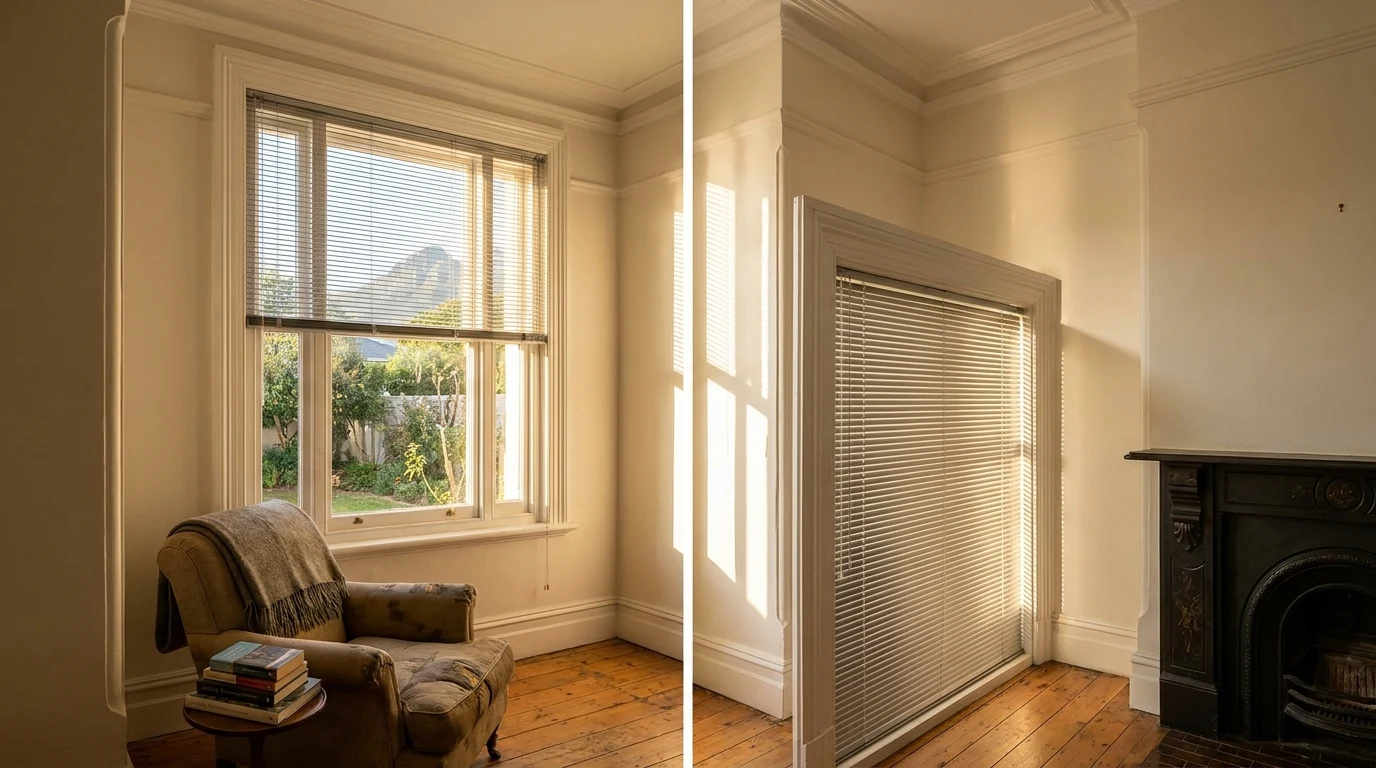
The blind this joinery was built around
Kenilworth Upper's street-facing rooms still carry their original woodwork: moulded architraves, timber sills, sash boxes, the angled alcove of a bay. A curtain hides all of that. A roller covers most of it. A venetian sits flat in the reveal, holds its line against the glass, and leaves every piece of the joinery on show.
That's the whole argument for slats, in one paragraph. The rest of this page is the practical detail — angle, material and measuring — for getting them right on windows this old.
02Privacy you set by degrees
Stands here sit close, and plenty of bedrooms and studies look straight at a neighbour's upper storey. Slats answer that overlooked-window problem with geometry rather than fabric. Tilt them upward and the room takes its light off the sky while the sightline from next door closes. Ease them down when the low afternoon sun starts reaching the desk. Shut them flat when you want the room entirely to yourself. Nothing else we fit adjusts in single degrees like this.
03Timber at the front, aluminium in the wet rooms
Under the oak canopy the front rooms take a soft, broken light, and 50mm basswood or bamboo slats meet it well — real grain, in scale with a Victorian opening, stained or painted to sit with the sills. Bamboo runs lighter than basswood for the same slat, which starts to matter on a wider sash.
Bathrooms, kitchens and the laundry are aluminium territory. A single-glazed sash pane streams with condensation on a July morning; powder-coated 25mm aluminium slats wipe dry and never swell — more than any fabric or timber can honestly promise in a wet room.
04Measuring an opening that isn't square any more
A century of settling means very few of these openings are still true. So we take widths at the head, the meeting rail and the sill, and work to the narrowest. We check the reveal depth against the sash's travel before promising an inside fit; where the reveal has become too shallow, we face-fix on the architrave rather than force it. And on a bay, each angled face is measured and made as its own blind — three faces, three blinds, one unbroken line of slats when you stand back in the room.
- Widths taken at three heights on every sash — the narrowest wins
- Each face of a bay measured and made as its own blind, on its own angle
- Hold-down brackets specified for sashes that stand open in the south-easter
The room we won't sell one for
A nursery that needs genuine two-o'clock darkness. However tightly they close, slats pass a sliver of light at their edges — for proper nap-time black, a blockout roller or a cellular blind does the job a venetian can't. We'll say so at the measure.
Asked at nearly every measure
Can one blind run across all three faces of a bay window?
The sashes stand open all summer — won't the slats knock about in the wind?
Bamboo or basswood — is there a real difference, or just a price one?
The same sash boxes and bay alcoves repeat street after street through the school-belt corridor, and the same measuring rules apply to every one of them. We fit slats across:
What venetian blinds cost in Kenilworth Upper
Slat material decides the band. Aluminium at twenty-five or fifty millimetres runs about R1,000 to R1,500 per square metre installed with wand and cord, and R2,500 to R3,600 per square metre motorised. Timber, which is usually what a sash window and a picture rail want, runs R1,600 to R2,600 per square metre hand-operated and R3,000 to R4,500 per square metre motorised.
Take these as guide bands rather than a quote. A small window carries a minimum charge, because the hardware and the fitting time barely reduce with the opening, and in an old house the awkward little windows are often the slowest ones. Every window gets its own figure after the free measure, in writing.
Slats measured to your reveals, not near them
One visit, every window measured, a written per-window quote to keep.
Book your free measure