Walk any Kenilworth street at four in the afternoon and count the shadows falling across the front windows. Almost none of them are cast by the house itself. An oak on the verge, a neighbour's gable, a boundary wall, a stand of pines two properties down — the comfort of a Kenilworth room is mostly borrowed from things the owner has no say over. This guide is about planning for that: which borrowed shade is reliable, which disappears, and what to fit for the hours when none of it helps.
Kenilworth is old ground with a young streetscape on top of it. The area was once farmland known as Weltevreden and passed through several names before settling on Kenilworth late in the nineteenth century; the racecourse opened in 1882 and pulled the suburb into shape around it.1 What that history left behind is a suburb of two grains — grand Victorian and Edwardian houses on wide, oak-lined avenues on the upper side, and a denser, more modest mix of family houses, semis and apartment blocks elsewhere.2
Both grains have the same peculiarity: the buildings are mostly low and the trees are mostly tall. That inverts the usual shading logic. In a suburb of double-storeys, a house shades itself and its neighbours. Here, a single-storey home with a hundred-year-old oak in front of it is being shaded by the tree, not the architecture — and a tree keeps its own calendar.
Before deciding on a single blind, stand in each problem room and ask a plain question: what is between this window and the sun, and do I own it? The answers sort into four categories, and each behaves differently.
Reliable, and yours
Your own eaves, verandah roof, garage wall or garden wall. Fixed geometry, no surprises. It shades high summer sun well and low winter sun hardly at all.
Reliable, and someone else's
The neighbour's double-storey, a boundary wall, an apartment block across the road. Steady until someone builds, extends or demolishes.
Seasonal
Deciduous street trees. Full cover in February, bare branches in July — which is why a room can feel perfectly comfortable in summer and glare unbearably in winter.
Absent
Open ground: the racecourse, a park, a school field, a wide road junction. Nothing between the glass and the sun, and nothing to slow the wind either.
Part two
The oak: brilliant for five months, gone for three
The oak-lined avenue is the signature of the older side of the suburb,2 and as a shading device it is close to ideal for half the year. A full canopy over a north or west window in January intercepts most of the direct beam before it reaches the glass, at no cost and with no maintenance. Nothing we sell does that job better in that month.
Two things go wrong with relying on it. The first is the calendar. Oaks are deciduous; by mid-winter the canopy is bare branches, and that is exactly when the sun is at its lowest — the noon sun in Cape Town sits at only about 31 degrees in June, against roughly 75 degrees at midsummer.3 Low sun comes in almost horizontally, straight through bare branches, at eye height, onto the television and the desk. A great many Kenilworth glare complaints are winter complaints for exactly this reason, and people are often surprised to hear it.
The second is that dappled shade is not the same as shade. Sunlight coming through moving leaves still carries ultraviolet, and it moves — a shifting, flickering pattern across a room that is far more tiring to read or work in than steady light. Timber floors and upholstery still fade under a canopy; it just takes a little longer.
Plan for the bare month, not the leafy one. A blind sized for July will be more than enough in January; the reverse is never true.
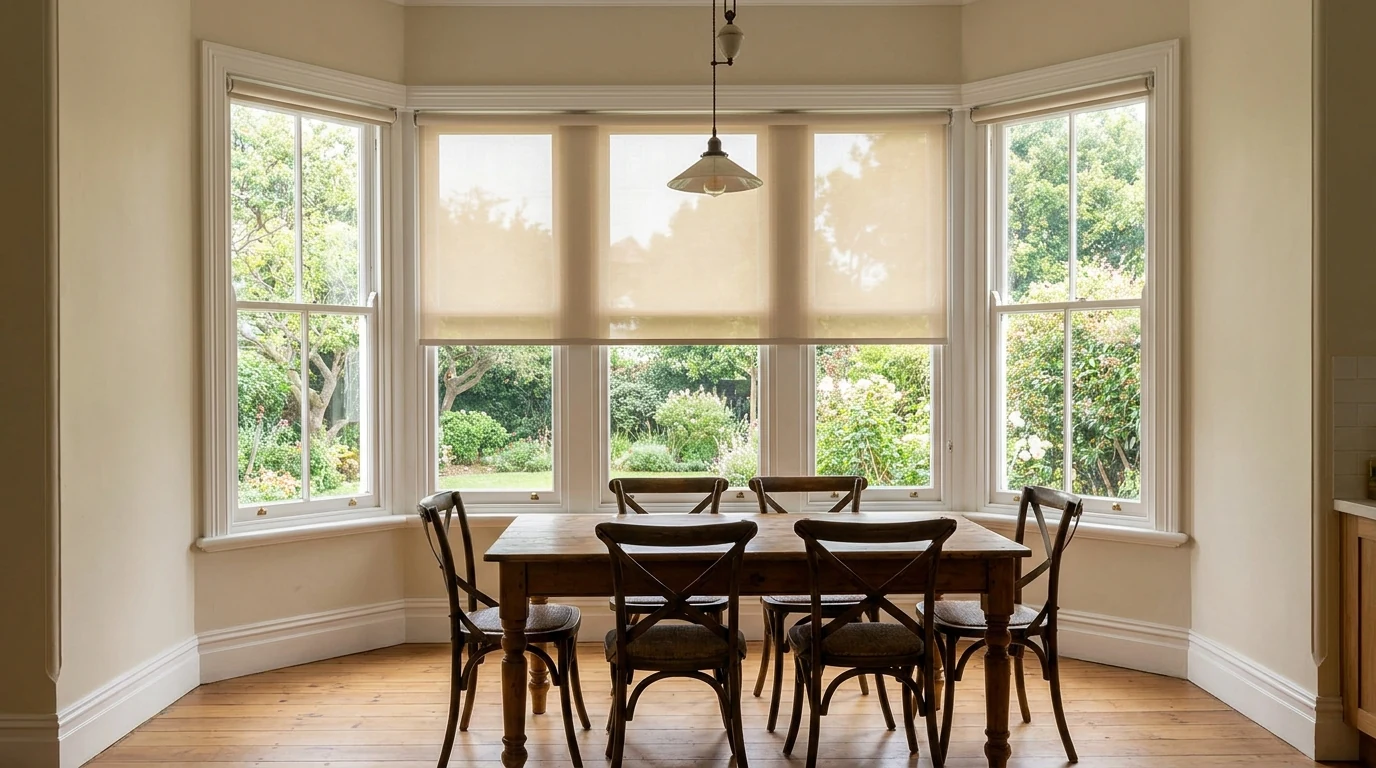
A sunscreen roller across a Kenilworth Upper dining bay — the mesh does the work in July, when the street canopy has nothing left to give.Part three
The gable next door, and the day it changes
On the tighter streets, the shade that makes a bedroom liveable at seven in the morning is very often the neighbour's roof. It is dependable — until a second storey goes up somewhere along the row, or comes down, and a room that has been comfortable for twenty years suddenly is not.
We see this most in semi-detached and closely spaced houses, where the two long elevations get almost no sun and the two short ones get all of it. It produces a specific brief: the end rooms need serious sun control, the middle rooms need light let in rather than kept out, and treating the whole house to one product wastes money at both ends.
What we'd specify
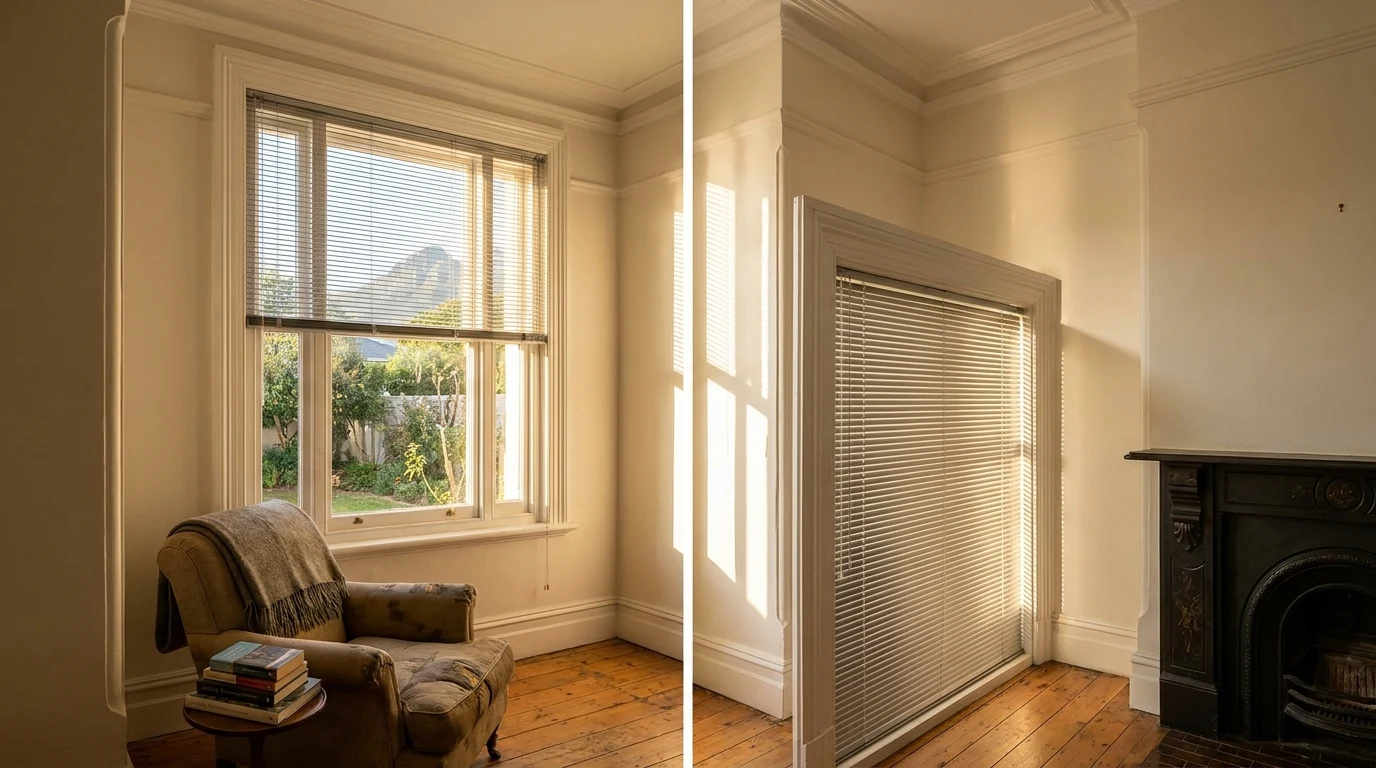
On the sunny end elevations, aluminium venetians if the room needs the light steered rather than stopped — tilting the slats upward bounces daylight off the ceiling and takes the beam off the furniture. On the shaded middle rooms, the least fabric that solves privacy: a day and night banded roller, which gives a screened view when the bands are offset and a closed one when they line up.
Where it falls short: venetian slats collect dust and need an occasional wipe, and a banded roller is a privacy product, not a blackout one. If a room must go properly dark, that is a separate blind, and we would rather quote two than pretend one does both.
Two windows in one Kenilworth Upper room, treated differently — raised on the garden side, closed flat where the sun lands beside the fireplace.Part four
The open ground at the end of the road
Kenilworth has an unusual amount of open space for a suburb this close to the city, and it is worth knowing what it is. Inside the racecourse lies the Kenilworth Racecourse Conservation Area, a reserve of roughly 52 hectares that has been left largely undisturbed for more than a century and is now regarded as the best-preserved remnant of Cape Flats Sand Fynbos anywhere, holding around 310 plant species, more than thirty of them threatened, along with the critically endangered micro frog.4
It is a genuinely remarkable thing to have at the end of a suburban street. It is also, from a shading point of view, half a square kilometre of nothing. Homes on the open edges of the suburb — facing the racecourse, a school field or a broad junction — get no borrowed shade at all, and take the wind unbroken as well. Cape Town's summer south-easter blows most consistently from October to March and is at its strongest in the afternoon, once the land has heated and the pressure difference with the sea has built.5 Open ground gives it a clear run.
This combination — no shade, full wind, low afternoon sun — is the one case in Kenilworth where an interior blind is simply the wrong tool, and where we would put the money outside the glass instead.
The premium answer for the exposed edge
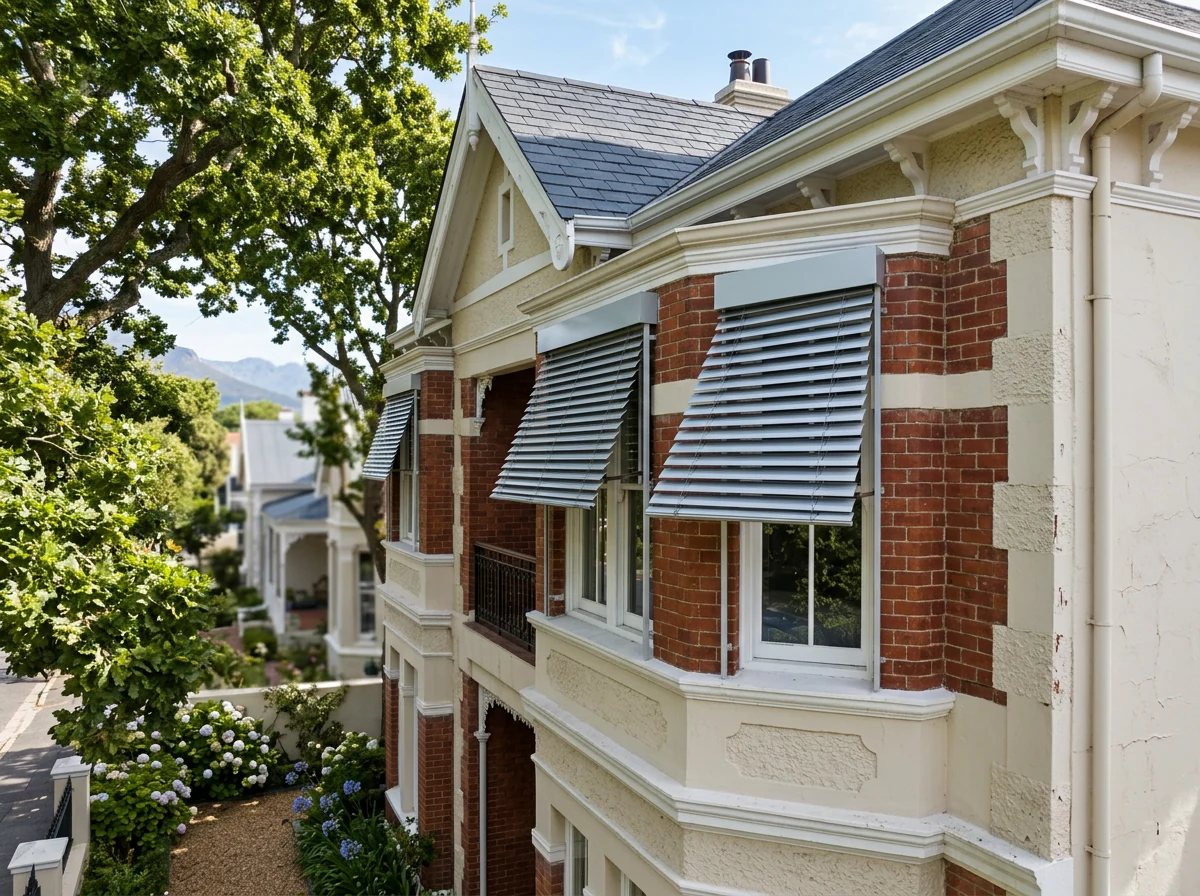
External venetian blinds lead here. Aluminium slats mounted outside the window, tilting as well as raising, so the beam is turned away before it touches the pane while the outlook over the open ground stays. Because the heat never gets through the glass, the room does not have to be cooled afterwards — an interior blind can only absorb energy that is already inside and re-radiate it.
Roller shutters are the heavier option: rigid slats running down from an external headbox, which shade, insulate and cut noise from a busy road all at once. Half-lowered they cover the top of a tall window and leave the sill open. Said plainly, these are shading shutters for sun, heat and glare — not security-rated products, which are a different item we can quote on request.
Zip screens are the answer where the wind is the real complaint. The mesh runs in side channels under tension, so it holds its shape in gusts that would fold an open awning arm, and it turns an unusable veranda into a room. Where an awning does suit a sheltered garden, we motorise it with a wind sensor so it retracts itself before a gust arrives rather than after.
Where it falls short: everything in this box fixes to the outside of the building, which costs more than an interior blind and raises the permission question in part seven. Where an exterior fixing genuinely is not possible, a sunscreen roller inside the glass is the sensible fallback — cheaper, and noticeably weaker on heat.
External venetians on the upper storey of a Kenilworth Upper villa — slats turned to hold the view while the direct beam is sent back outside.Part five
The mountain, and the hour it takes back
The last piece of borrowed shade is the largest. The Table Mountain range stands to the west of the whole southern suburbs, and it takes the end of the afternoon back from Kenilworth long before the printed sunset time. In midsummer the sun sets on a bearing of about 240 degrees — south of due west — and in midwinter about 297, well to the north of it,3 so the point at which the mountain cuts the light off shifts through the year as well.
Two practical consequences. First, the difficult hour arrives earlier than people expect, and ends abruptly rather than fading — which is why so many households never get round to drawing anything until it is already too late. Second, the same range wrings the moisture out of the winter weather on this side: the eastern slopes take more than four times the rainfall of the drier western side of the mountain.6 That is why a Kenilworth specification has to answer two opposite questions at once — keep the summer heat out, and keep the winter warmth in.
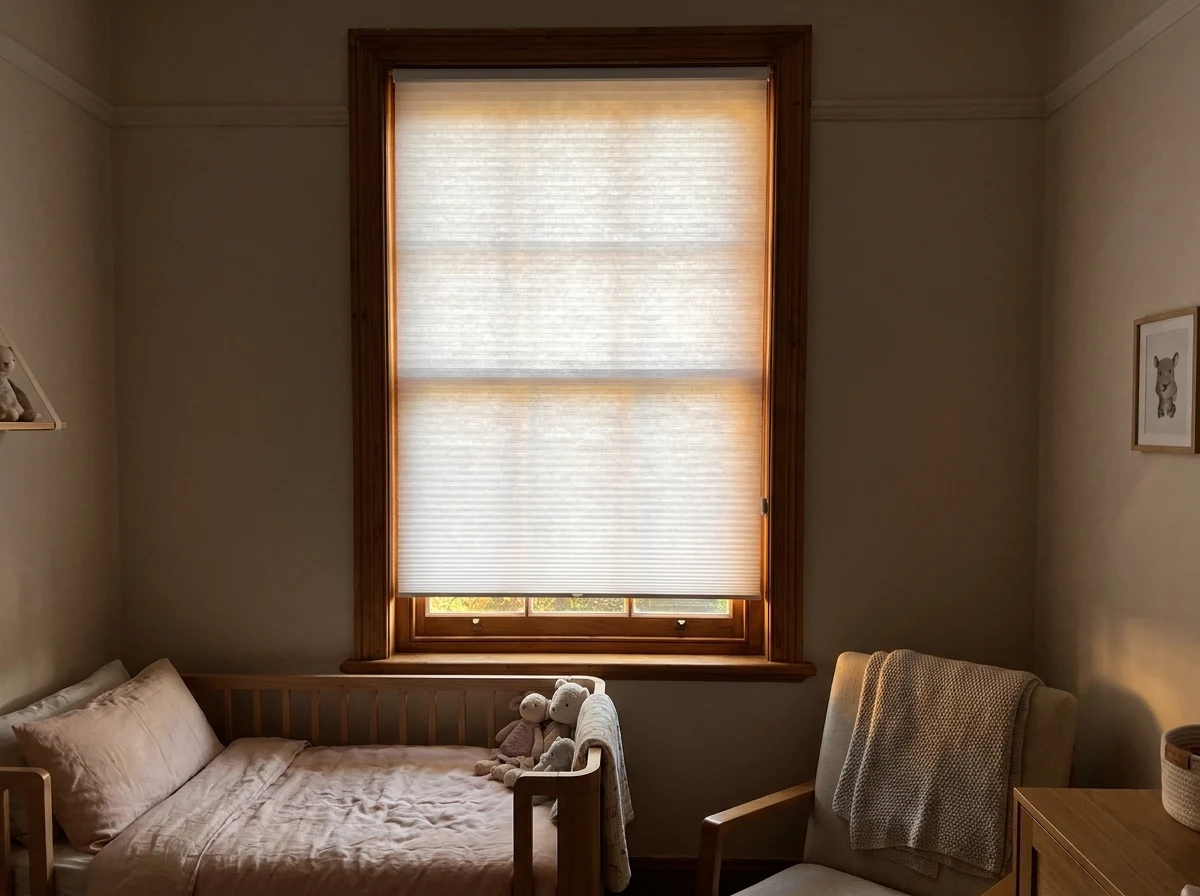
The second half of that is what a cellular honeycomb blind is for. The honeycomb structure traps a layer of still air against the glass, and still air is what insulates; on a cold, wet July evening it is the difference between a room that holds its warmth and one that bleeds it out through the window.
A cellular blind in a Kenilworth Upper nursery — the trapped air in the cells is doing the insulating, not the fabric.Part six
Fitting for the hours nothing else covers
Once the inventory is done, the shopping list mostly writes itself. Rooms that are well borrowed-shaded for most of the day need only the last hour solved. Rooms with nothing between them and the sky need a real system. A short summary of how we tend to land on it:
Street-facing rooms under a canopy — sunscreen mesh at around 5% openness. Cuts the winter glare and a good share of the UV without cancelling the view of the avenue that made you buy the house.
Bedrooms — blockout. And be aware that blackout is a fitting problem, not a fabric one: every blockout fabric is opaque, and the light you notice at six in the morning is the strip coming in beside the blind. Inside the reveal looks neat and leaks a little; over the opening is far darker and hides the timber.
Kitchens, bathrooms and sculleries — aluminium venetians, because steam, splashes and scrubbing will kill anything else.
Wide sliding or stacking doors — panel or vertical systems that draw fully clear of the opening, so the door still works as a door.
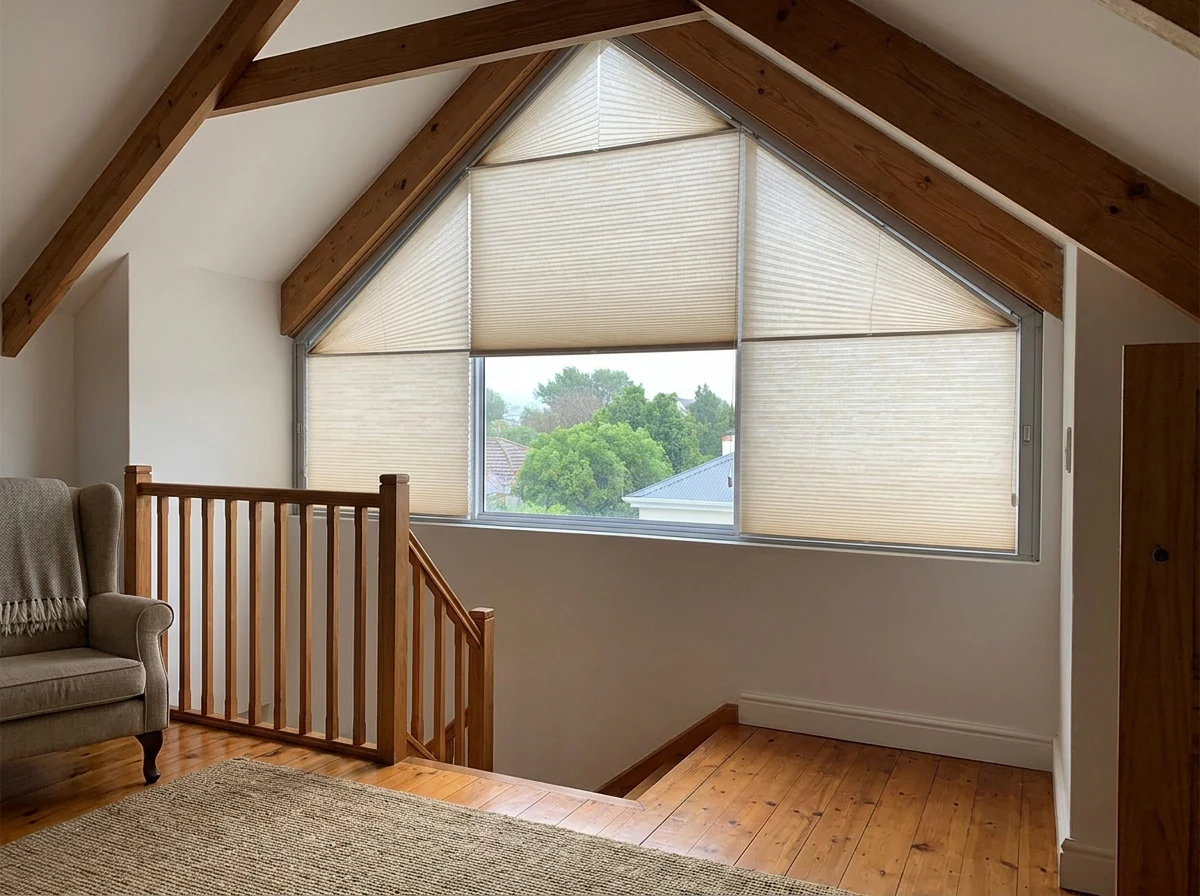
Stairwell and high gable glass — motorised, without argument. A blind nobody can reach is a blind nobody uses, and a shaped or skylight system built to the actual pitch beats a rectangle fudged to fit.
Anything on the exposed edge — outside the glass, as set out in part four.
Shaped blinds cut to the actual pitch of a Kenilworth Upper gable — the alternative is a rectangle and a permanent triangle of glare.Part seven
Old houses and what may be fixed outside
A good deal of Kenilworth's housing stock is well past its sixtieth birthday, and that matters legally rather than aesthetically. Under the National Heritage Resources Act, no one may alter or demolish a structure — or part of a structure — older than 60 years without a permit from the provincial heritage resources authority, which here is Heritage Western Cape.7 A blind inside the reveal changes nothing about the structure and raises no such question. A headbox, guide rail, awning cassette or screen channel bolted to the facade is another matter entirely.
Where the property is sectional title or in a complex, there is a second gate: the trustees or body corporate must agree to anything that shows on the outside, and that agreement is wanted before an order is placed, not after a delivery arrives.
Our part is to make the application easy — slim profiles, restrained colours, product data, drawings and a written specification. What we will not do is describe an approval as a formality or lodge it in your name. That sits with the authority, the trustees and, on a house that deserves it, a heritage professional.
Part eight
Five things a photograph will not tell us
How deep the reveal really is, at top, middle and bottom. Old openings settle out of square, and a difference of a centimetre decides whether the headbox sits inside the joinery or stands proud of it.
What the wall is made of behind the plaster. Solid brick, cavity, later stud work or a steel lintel — that decides the fixing, and whether anything external can safely be hung there at all.
The true bearing of each room. Streets bend, extensions get added to whichever side had space, and half the rooms people describe as "west-facing" turn out to be south-west, which changes the answer.
What the neighbours' buildings and trees actually block, and when. Standing in the room at the hour that bothers you is worth more than any calculation we can do at a desk.
Where the power is, and who must approve. Whether a motor has a socket within reach, whether a battery tube can be recharged without a ladder, and whether trustees or a heritage authority have a say in what shows from the road.
That is the real reason the measure is free: every one of these is cheaper to discover before a quote than after an installation.
Next step
Have us take the inventory with you
A consultant walks the house, notes what shades each window and when, checks the five things above, measures every opening to the millimetre and leaves you with a written, itemised, per-window quote. Free, and with no obligation either way.
→
No call-centre hold music
A real consultant calls you back to arrange a time that suits your Kenilworth property.
→
Nobody prices a window they have not seen
The quote comes after the measure. We will not guess a figure down the phone.
References
Where these facts come from
Every date, figure and measurement above is traceable to one of the sources below. The recommendations are our own opinion and are marked as such, not dressed up as findings.
South African History Online — Kenilworth (the area's earlier identity as Weltevreden, the sequence of name changes, and the opening of Kenilworth Racecourse in 1882).
Seeff Property Group — Kenilworth area profile (well-preserved Victorian and Edwardian architecture along oak-lined avenues on the upper side, alongside a more modest housing mix elsewhere in the suburb).
Gaisma — Cape Town sun and moon data (December-solstice elevation at 12:00 about 75° and sunset bearing 240°; June-solstice elevation at 12:00 about 31° and sunset bearing 297°). Where this page gives a noon altitude it means solar noon, calculated from the latitude and a ±23.44° declination; above are the source's 12:00 values.
Wikipedia — Kenilworth Racecourse Conservation Area (about 52 hectares; undisturbed for more than a century; the best-preserved patch of Cape Flats Sand Fynbos; roughly 310 plant species, more than thirty of them threatened; the critically endangered micro frog).
Cape Town Current — Cape Town wind guide (the south-easter blows most consistently from October to March, is funnelled and accelerated by the peninsula's terrain, and is strongest in the afternoon).
The Fynbos Guy — The Cape climate (the eastern slopes of the range receive more than four times the rain of the drier western slopes).
SAFLII — National Heritage Resources Act 25 of 1999, section 34 (a permit from the provincial heritage resources authority is required to alter or demolish any structure, or part of one, older than 60 years).
The shade inventory, the product recommendations and the trade-offs set out above are our own working and our own opinion, given free and without obligation. Nothing here is a heritage-approval opinion; that belongs to Heritage Western Cape, the City of Cape Town and your own professional team.